'Swing Essentials' start with grip
 By
By 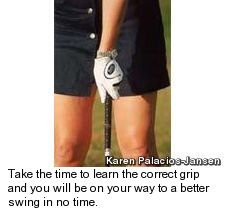 This is the first part in golf instructor Karen Palacios-Jansen's "Swing Essentials" series on building a fundamental golf swing. Here, Palacios-Jansen focuses on finding the right golf grip for your game.
My teaching philosophy is to instill the importance of the basic fundamentals, or "swing essentials" as I call them, to my students.
Once people have mastered the "essentials" of a good full swing and are confident with their ball striking, I like to work on other parts of the game: Teaching the short game, specialty shots, mental toughness and good course management. These all help people lower their scores and increase their level of enjoyment on the golf course.
So let's get started with one of the most important aspects of the golf swing.
Swing Essential No. 1: The golf grip
Your hands are the only part of your body that touch the golf club. Your hands influence how you set up to the ball, the path that the club takes on the backswing, the angle clubface at impact and how fast you can swing the club. Take the time to learn the correct grip and you will be on your way to a better swing in no time.
To be a consistent ball striker, you should strive to find a grip that helps you return the clubhead square to the ball at impact with effortless power. A neutral grip for me and a neutral grip for you may not be the same, so don't think that you have to put your hands on the club the same exact way as everyone else. In fact, forming a good grip is like art. You shape and mold your hands to the club until you find the most pleasing grip.
Here is an easy way to find your grip:
1. Stand straight with arms relaxed and hanging at your side. Notice how the thumb of your left hand hangs down (your right hand thumb if you are a left-handed golfer). If your thumb hangs to the right, then your thumb should be placed on the right side of the shaft. If it hangs to the middle, then it should be placed in the middle of the shaft.
 2. Adjust your thumb with your left hand until you find what works best for your hand. Be cautious not to let the thumb of the left hand go straight down the shaft it should never be placed on the left side of the shaft. If you thumb is placed on the left side of the shaft, then you will have a weak grip that will inhibit the hinging of the wrists. It may feel comfortable, but it won't be effective.
3. Now for the right hand. Think of the palm of your right hand as being the clubface. Make sure your right palm is perfectly square to the clubface, just as it would be at impact. With your right fingers spread, place the lifeline of your right hand snuggly on top of the left thumb and wrap the rest of your fingers around the shaft. Hook your right forefinger around the shaft and spread it a little longer than the rest of your fingers, as if on a gun's trigger. I gently press the lifeline of my right hand on top of my left thumb to make sure my hands are joined as one.
Experiment with your grip positions to find the one that suits you best.
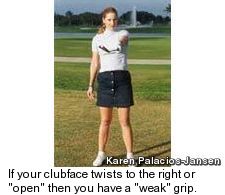
Now, let's see what is happening to your clubface at impact. Simply grip the club like you would normally with just your left-hand and raise the club up until the club is parallel to the ground.
Stretch your arm out. The leading edge of the clubface should be perpendicular to the ground or what we teachers call the "square" position. If your clubface stays "square," then you are in good shape. If your clubface twists to the right or "open" then you have a "weak" grip. If clubface "closes" or twists to the left, you have a "strong" grip.
There three basic ways to join your hands together to finalize your golf grip.
• The Vardon Grip: The most widely used grip by golf professionals is called the Vardon grip, named after the grip's inventor, Harry Vardon. This is where you piggyback the pinkie finger of your right hand on top of the forefinger of your left hand.
• The Interlocking Grip: The interlocking grip is where you interlace the pinkie finger on your right hand with the forefinger of the left hand.
• Baseball or 10 Finger Grip: This is where all 10 fingers are securely on the shaft, as if you were holding a baseball bat.
How you join your hands together is up to you. Use whatever grip feels comfortable to you. Most importantly, use the grip that helps you square the clubface at impact with the least effort. Experiment with your grip by hitting balls with the different grips to see what works best.
December 4, 2007
Golfers need to learn Ball Flight Laws for maximum swing self-correction
To improve your swing, you must know why the ball does what it does in flight. That way you at least know what really caused the errant shot and perhaps can make the correct fix. You must understand the simple Ball Flight Laws.
... full article »- Pay close attention to those practice swings
- What the PGA Tour pros know: The importance of having an effective pre-shot routine

tim hayes wrote on: Jan 27, 2016
Karen
I have been playing 19 years and only now realise the absolute importance of the correct grip or hold on clubCorrect grip stops over the top yips/uncumfortable
makes you feel powerful at setup(sit on stool feeling to bring legs alive
alignment happens as a bi product of that grip.wow
I could go on about the grip forever
all my lifes golfing woes and I like most other hackers never took the time to properly think about the grip and how it changes the bodies dynamics
thank you Karen for taking the time
and different angle on how hands should work.
Us ameteurs shouldnt even be allowed to swing a golf club until we have a proper grip.
Then the golf world would change and there would be so many more players that could actually play this wonderful game.
(sorry this took so long)
Reply
Siscoe Kid wrote on: Jan 24, 2014
I play all my life with a week grip not knowintg it. Now I understand the tremendous impact on the rest of my swing.
Reply
Phil wrote on: Apr 19, 2011
I hope the picture on the top right isn't what's being advocated or alot of guys will be hooking the ball. That is one heck of a strong grip! Might be neutral for the author but that's pretty strong if you ask me. Looks like she can see atleast 3 knuckles, the V points to her bicept, and her wrist is very cupped at address.
Good instructions though, just the picture could throw alot of people off.
Reply
Mike wrote on: Jun 9, 2010
Thanks for your lesson on grips..I have never heard it expained so clearly and that stretches over a lot of years..
Reply
Parshooters wrote on: Mar 5, 2010
I like your article a lot. Very well written with loads of information. The golf grip is the essential fundamental building block to having the proper way to swing a golf club.
Reply
Rick wrote on: Jan 4, 2009
I have experimented with the interlocking grip and the 10 finger baseball grip. I have more confidence and better feel with the 10 finger approach as it provides more balance and better stricking ability. It defininately provides better feel for putts. I think choking up a bit say 1 or 1-1/2 inches ala Kim is a good thing too.
Reply
Jesus D. Macachor, M.D. wrote on: Jun 1, 2010
There is a reason for the popularity of the Vardon and Interlocking grip. Both of them are more powerful than the 10 finger or baseball grip. Reason: THE RIGHT HAND IS SLIGHTLY UNDER THE LEFT HAND AND THE CLUB TOWARDS THE TOP OF THE SWING, THEREFORE THE RIGHT HAND CAN PUSH AND PULL THE LEFT HAND HIGHER FOR LONGER AND WIDER ARC AND ALSO PROMOTES A BETTER SHOULDER TURN.
Reply
Andrew wrote on: Jun 18, 2010
Vardon and Interlocking work best because they are far better at making the hands work as a single unit. I can't accept the argument that one grip is more powerful than the other. Practically, a fine golfer keeps his hands quiet through impact. He's not going to push/pull any harder regardless of grip. Moreover, there is so much inertial force to overcome on the downswing, it would be physically impossible to generate measurable differences in swing speed using the various grips.
Reply
Lou Catalfo wrote on: Aug 6, 2008
I took a careful look at your grip instructions and I'd have to say that my grip is right on. However, like Bill Freund I fight the hook constantly. I feel this is due more to grip pressure than actual grip set-up. Could you recommend something that helps maintain a soft and light grip pressure? I feel I roll my right hand over because of tension in my arms. Would fatter grips help to prevent this from happening? Thanks.
Reply
John Moore wrote on: Aug 23, 2011
I was given a tip regarding grip pressure that has really helped. Once I am set-up, but before I waggle, I grip the club as hard as I can, then back-off the grip pressure to a more relaxed state. It seems to work as a deep breath might before shooting a free throw, or firing a gun, in order to focus, yet relax.
Reply
Bill Freund wrote on: Feb 1, 2008
I obsess about the grip. It seems that I don't mold my left hand properly to the grip. I'm 5'7" and maybe my clubs are too tall for me. I seem to have a hard time getting my left hand to lie down softly and properly on the grip. As a result, my right hand grip is off and I hit these 2 fairway over hooks as a result. Do you have any suggestions before I kill myself or worse give up the game?
Thanks,
BIll Freund
Reply
brian wrote on: Jul 26, 2011
keep the grip you like and open the face of the club a litle and swing away!
Reply