


Reserva Conchal Golf Club

Rating Snapshot


About
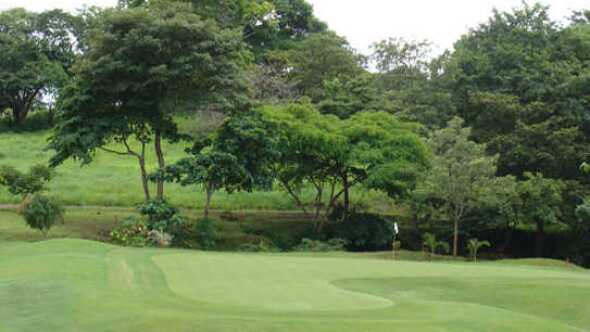
Robert Trent Jones Jr. designed the course at Reserva Conchal Golf Club to impress. Both nines course over rolling terrain with excellent views. The par-71 golf course tests and inspires with its eco-golf aesthetic: Ravines and lakes are pretty - and pretty tough, making accurate shots toward well-manicured Bermuda greens essential.
A round at Reserva Conchal Golf Club starts on a 319-yard par-4 that's tougher than it looks; stow the driver in favor of a fairway wood or long iron, and shoot precisely to miss the ravine blocking the shallow green on two sides. The fourth is the longest, a 585-yard par-5 that requires you to shoot left from the tee; on the second shot, avoid a big tree to near the shallow green, and then hit a high approach. The last hole is also long, at par 5 and 547 yards, so, if you're feeling lucky, go for the green in two with a fairway wood or long iron to clear the water.
"Reserva" means "reserve," so take advantage of your day at the Reserva Conchal Golf Club, and take a guided tour of the onsite wildlife refuge.
| Tee | Par | Length | Rating | Slope |
|---|---|---|---|---|
| Gold | 71 | 7021 yards | 74.9 | 137 |
| Blue | 72 | 6558 yards | 72.5 | 129 |
| White | 72 | 6023 yards | 70.1 | 124 |
| Red (W) | 72 | 5323 yards | 71.8 | 126 |
| Hole | 1 | 2 | 3 | 4 | 5 | 6 | 7 | 8 | 9 | Out | 10 | 11 | 12 | 13 | 14 | 15 | 16 | 17 | 18 | In | Total |
|---|---|---|---|---|---|---|---|---|---|---|---|---|---|---|---|---|---|---|---|---|---|
| Gold M: 74.9/137 | 317 | 442 | 474 | 592 | 216 | 435 | 535 | 181 | 422 | 3614 | 454 | 189 | 435 | 448 | 404 | 154 | 557 | 210 | 556 | 3407 | 7021 |
| Blue M: 72.5/129 | 299 | 423 | 452 | 569 | 191 | 413 | 517 | 147 | 394 | 3405 | 423 | 165 | 411 | 421 | 352 | 150 | 530 | 186 | 515 | 3153 | 6558 |
| White M: 70.1/124 W: 71.2/127 | 275 | 400 | 427 | 536 | 157 | 386 | 487 | 125 | 369 | 3162 | 394 | 141 | 337 | 400 | 323 | 124 | 501 | 154 | 487 | 2861 | 6023 |
| Red W: 71.8/126 | 247 | 347 | 377 | 483 | 131 | 337 | 433 | 99 | 328 | 2782 | 350 | 104 | 316 | 379 | 288 | 99 | 481 | 109 | 415 | 2541 | 5323 |
| Handicap | 15 | 5 | 1 | 9 | 13 | 3 | 11 | 17 | 7 | 6 | 14 | 4 | 2 | 16 | 18 | 10 | 12 | 8 | |||
| Par | 4 | 4 | 4 | 5 | 3 | 4 | 5 | 3 | 4 | 36 | 4 | 3 | 4 | 4 | 4 | 3 | 5 | 3 | 5 | 35 | 71 |
Course Details
Rentals/Services
Practice/Instruction
Policies
Available Facilities
ClubhouseReviews

Beautiful course with amazing views!
Beautiful course. The course plays extremely long so be prepared to hit 1 to 3 extra clubs per shot due to the humidity, thick fairways and uphill slope on most holes. They cut the fairways every 3 days instead of daily like most stateside courses. Overall, it's a fun track with amazing views.
Good but not great
January is the dry season, so the course played hard and fast. It probably had not rained in 60 days. That being said the course was very playable except for the bunkers. Being a RTJ course there a lot of them. They were hard as a rock.
Quite a lot of interesting holes. The par 5s are all excellent. Best greens that we played on a 2 week stay in Costa Rica. Fast and smooth. If you go this time of year don't expect a lot of green but there is a loot of grass on the fairways.



Escape To Reserva Conchal Package


