|
Jacobsen Hardy Golf
|
|
In addition to their friendship, which had grown throughout the years, Hardy said their likeness in thinking on course development made the decision to create a company that much easier. "Our philosophies on golf course design were absolutely identical," he said.
Those philosophies are what make Jacobsen Hardy unique. There are several components that make up their overall philosophy. The first of which is the correct degree of challenge or fairness in course design. "I know where bad golfers miss golf shots. I also know what is a challenge for a good golfer, as Peter does, and I know what is an unfair challenge for bad golfers."
Hardy said you can build a course where each hole has a 20-foot-wide fairway, out-of-bounds on both sides and every green is perched in the air where it is extremely difficult to fly the ball on the green and stop it. In addition, you could make each hole 470 yards long. He said he would consider that type of course to be unfair. He poignantly added that Bethpage in New York, which hosted the 2002 U.S. Open, was very similar to the description. "Peter and I both agree what we think a fair test is," Hardy said.
Although knowing fairness is one thing, incorporating it is another and much more important according to Hardy.
"We'll do two or three holes on each nine that are very difficult by design. We'll have only two forced carries on each nine. The rest of the time we let the golfer bounce the ball on to the green," he said, recognizing that the average golfer does not always end up on the green through the air.
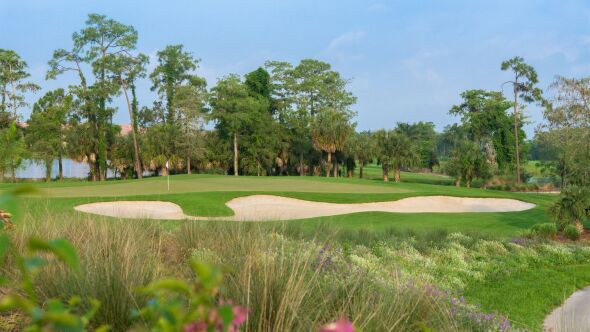
As a result, on all Jacobsen Hardy-designed courses, he said there is a direct correlation between the difficulty or trouble around the green and the likely distance of the approach. "The longer the par 3 or 4, the longer the shot into the green, and you need a larger target that is open in front and on grade. If you're going in to the green with a 3-wood, they need to land the ball 30 yards short of the green. We can't put the green jacked up in the air with a great big bunker in front."
While there are difficult holes found on all Jacobsen Hardy courses, the designers like to balance it out with several less demanding holes, or "redemption" holes such as two-shot par 5s, short par 4s or simpler par 3s. "These holes aren't giveaways but we're asking the players to make good scores on them if they play the hole correctly."
Hardy said this particular design philosophy is a direct influence from Augusta and its back nine, which features a combination of difficult and relatively easy holes. He said hole Nos. 10-12, or Amen Corner are three incredibly taxing holes while hole Nos. 13 and 15 are reachable par 5s or the "redemption" holes. The other four play to standard par. "That's what we try to do is give the golfers two or three difficult holes per nine, two or three redemption holes and the rest that play to standard par so you create offensive and defensive golf."
Regardless of the varying hole complexity, Hardy said he and Jacobsen strive to provide an assortment of settings that the golfer can enjoy whether they just scored a 9 or a 3 on the previous hole. "We like to create different environments on the golf course so when you play the first or second holes and you see how the green settings are, how the bunkers are and everything else, you haven't seen all 18. We're going to change that on you."
While fairness and varied settings are two key components for Jacobsen Hardy, the most unique element to their overall philosophy has nothing to do with architectural renderings or any other facets of the design or appearance of the course. This distinct ingredient comes much earlier in the process when the Jacobsen Hardy design team first sits down with the property owner.
Although it is common practice and preferred by some designers for the property owner to give the architect free reign with the land essentially saying - "Here is the land. Go build me a golf course." - Jacobsen and Hardy refuse to conduct business that way. They believe inclusion of the property owner and his or her vision is crucial to the overall success of the project.
Hardy said in the initial meeting, they are on a quest seeking out ideas from the owner. "We start off by asking who is going to play the course - people who will buy houses, daily fee, private, semi-private, university golf course. Second, we try to find out how much the owner can afford to spend in order to charge X amount of dollars for green fees, dues or initiation fees, and for how many people and how many rounds a year. And, ultimately, does all of it put together make sense."
In more simple terms, Hardy said a golf course is like a car. "You have Yugos and you have Ferraris. Similarly, you have $8 green fee courses and exclusive clubs like Shadow Creek in Las Vegas. They all cost different money to build, operate, to play, and there is a different clientele they're trying to appeal to."
Hardy said once the type of golf course and the amount of available funds are determined, in addition to a close inspection of the property, they then give an estimate. He said there has to be a match with the owner's vision. "Once we attune with what the dream is, then we start designing the golf course. The owner is a member of our design team but he has already been a member because we haven't shut him out in the initial process. When you include them, they start to get excited about it, and they start giving input, and they understand what is going on."
|
Hardy said this approach of inclusion is a direct result of his days as a developer, project manager, and construction manager of more than 40 courses, as well as his time as an apprentice under well-known designer Tom Fazio. "Tom would go to the owner and ask who was the rep and who wanted to be involved. He would tell them this is going to be yours when we're through and I want your sign off."
As a result of this and all components that make up the Jacobsen Hardy design philosophy, 13 courses (four in Texas) have been completed, where the owners are happy, the design team is happy, and ultimately, the golfer is happy. Quite impressive when you consider it all started with a PGA Tour player who wanted a few tips on his golf swing.
For more information on future projects of Jacobsen Hardy Design, go to www.jacobsenhardy.com. Comment on this story on our reader feedback page.
Agree with this review? Disagree?
Post your thoughts at GolfBoards.com.